Demo3 - Fault Diagnosis and Identification
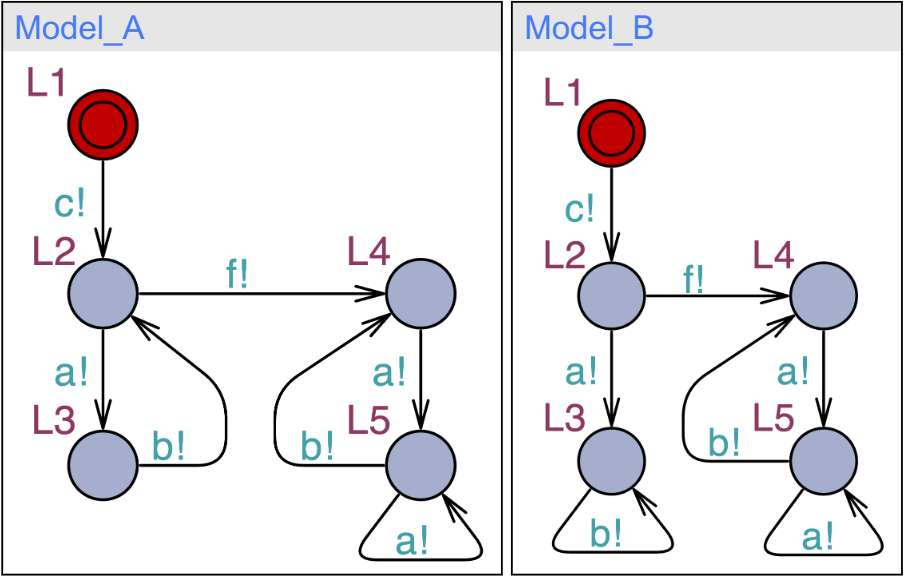
This demo shows two slightly different automata, Model_A and Model_B, with observable actions $\Sigma^o$ = [a, b, c], and unobservable actions $\Sigma^{un}$ = [f]. The following four propositions presented are logically straightforward and easily reasoned, as they are based on a simple example:
Suffix
aaaimpliesf. For suffixaaa, bothModel_AandModel_Bidentifyf, as it can only be observed post-occurrence off.Suffix
abadoes not confirm $f$ inModel_AThe sequence $aba$ can occur during normal and fault conditions inModel_A. Therefore,abadoes not conclusively suggestfhas occurred.Fault
finModel_Ais not 3-Diagnosable. Given that the observation suffixaba, covering three events, occurs in both normal and fault modes ofModel_A, it’s impossible to unequivocally diagnosefwithin this span. Thus,Model_Ais not 3-diagnosable.Fault
finModel_Bis 3-Diagnosable. InModel_B, the three-event suffixes[abb, bbb]are exclusive to the normal mode and absent in the fault mode. Conversely,[aaa, aab, aba, bab, baa, bab]are unique to the fault mode. The absence of common suffixes between modes inModel_Bguarantees its 3-diagnosability, ensuring accurate fault identification from any three-event sequence.You can download the models: model_A.xml and model_B.xml.
import pyuppaal
from pyuppaal import UModel

print(pyuppaal.__version__)
pyuppaal.set_verifyta_path(r"C:\Users\10262\Documents\GitHub\cav2024\bin\uppaal64-4.1.26\bin-Windows\verifyta.exe")
1.2.1
1. Fault Identification
Temorary files tmp_identify_id.xml will be saved. For more details, please read the docs of UModel.fault_identification().
Suffix
aaaimpliesf. For suffixaaa, bothModel_AandModel_Bidentifyf, as it can only be observed post-occurrence off.Suffix
abadoes not confirm $f$ inModel_AThe sequence $aba$ can occur during normal and fault conditions inModel_A. Therefore,abadoes not conclusively suggestfhas occurred.
m_a, m_b = UModel('model_A.xml'), UModel('model_B.xml')
sigma_o, sigma_un = ['a', 'b', 'c'], ['f']

# identification for fault 'f' with o1 = ['a', 'a', 'a'] and o2 = ['a', 'b', 'a']
o1, o2 = ['a', 'a', 'a'], ['a', 'b', 'a']
res1_a = m_a.fault_identification(o1, fault='f', sigma_o=sigma_o, sigma_un=sigma_un)
res1_b = m_b.fault_identification(o1, fault='f', sigma_o=sigma_o, sigma_un=sigma_un)
print(f"{o1} can identify 'f'. Model A: {res1_a[0]},  Model B: {res1_b[0]}.")
res2_a = m_a.fault_identification(o2, fault='f', sigma_o=sigma_o, sigma_un=sigma_un)
res2_b = m_b.fault_identification(o2, fault='f', sigma_o=sigma_o, sigma_un=sigma_un)
print(f"{o2} can identify 'f'. Model A: {res2_a[0]}, Model B: {res2_b[0]}.")
assert res1_a[0] == True
assert res1_b[0] == True
assert res2_a[0] == False
assert res2_b[0] == True
['a', 'a', 'a'] can identify 'f'. Model A: True,  Model B: True.
['a', 'b', 'a'] can identify 'f'. Model A: False, Model B: True.
2. Fault Diagnosability
Temorary files tmp_diagnosable_suffix_id.xml will be saved. For more details, please read the docs of UModel.fault_diagnosability().
Fault
finModel_Ais not 3-Diagnosable. Given that the observation suffixaba, covering three events, occurs in both normal and fault modes ofModel_A, it’s impossible to unequivocally diagnosefwithin this span. Thus,Model_Ais not 3-diagnosable.Fault
finModel_Bis 3-Diagnosable. InModel_B, the three-event suffixes[abb, bbb]are exclusive to the normal mode and absent in the fault mode. Conversely,[aaa, aab, aba, bab, baa, bab]are unique to the fault mode. The absence of common suffixes between modes inModel_Bguarantees its 3-diagnosability, ensuring accurate fault identification from any three-event sequence.
# n-diagnosability for fault 'f', for n=3
res3_a = m_a.fault_diagnosability(fault='f', n=3, sigma_o=sigma_o, sigma_un=sigma_un)
res3_b = m_b.fault_diagnosability(fault='f', n=3, sigma_o=sigma_o, sigma_un=sigma_un)
print(f"Model A is 3-diagnosable: {res3_a[0]}, reason: {res3_a[1].untime_pattern}.")
print(f"Model B is 3-diagnosable: {res3_b[0]}.")

assert res2_a[0] == False
assert res2_b[0] == True
Model A is 3-diagnosable: False, reason: ['c', 'a', 'b', 'a'].
Model B is 3-diagnosable: True.